

Paper Cup Raw Materials: Complete Guide for Paper Cup Manufacturers
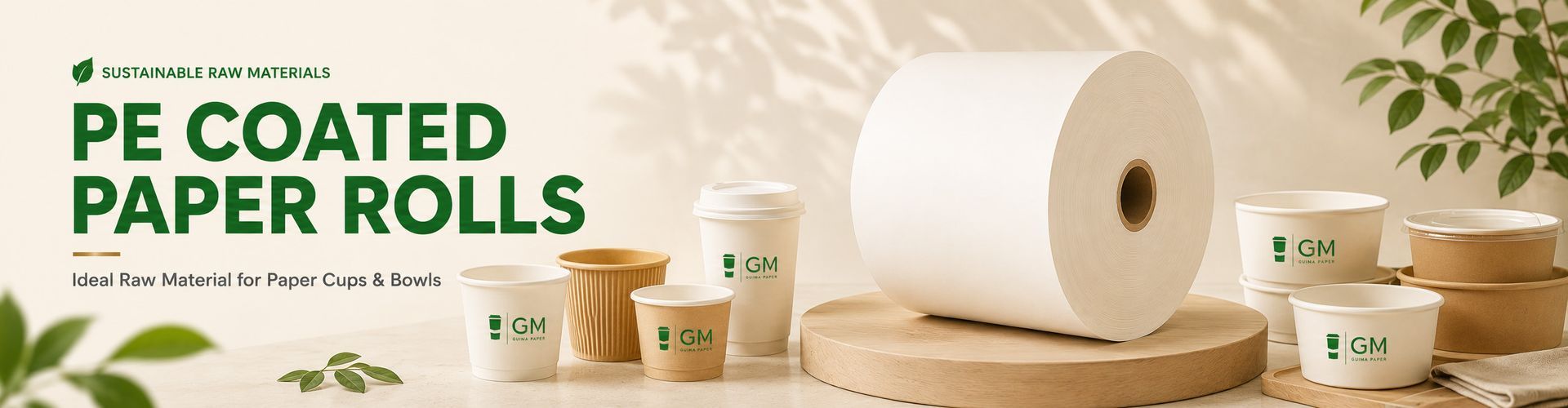
Choosing the right paper cup raw materials is one of the most important decisions in paper cup manufacturing.
The quality of the raw material directly affects the stiffness of the finished cup, printing quality, heat-sealing performance, leakage resistance, production efficiency, and the overall experience of the end user.
For a paper cup factory, purchasing paper is not simply about comparing the price per ton. Two materials with the same grammage can perform very differently because of differences in paper thickness, bulk, stiffness, fiber quality, coating uniformity, moisture content, and sealing performance.
This guide explains the main types of paper cup raw materials, how they are processed, what specifications buyers should consider, and how to choose suitable materials for different paper cup and paper bowl applications.
What Are Paper Cup Raw Materials?
Paper cup raw materials are the paper-based materials used to manufacture disposable paper cups and related food-service containers.
Depending on the production stage of the buyer, these materials can be supplied in different forms. The main types include:
- Cupstock base paper
- PE coated paper rolls
- Printed or blank paper cup fans
- PE coated paper bottom rolls
A paper cup factory with its own coating, printing, and die-cutting equipment may purchase cupstock base paper. A converter may purchase PE coated paper rolls for printing and die-cutting. A paper cup factory focused mainly on cup forming may prefer ready-to-use paper cup fans and bottom rolls.
Therefore, the right raw material format depends not only on the cup design but also on the buyer's production equipment and manufacturing process.
The Four Main Types of Paper Cup Raw Materials
1. Cupstock Paper
Cupstock paper is the base paperboard used for paper cup production.
It provides the main structure of the cup and influences stiffness, thickness, forming performance, and the feel of the finished product.
High-quality cupstock paper should provide a suitable balance between grammage and physical performance. Paper with insufficient stiffness may produce cups that feel soft or deform easily during use. At the same time, selecting excessively heavy paper can increase production costs without providing a proportional benefit.
When evaluating cupstock paper, professional buyers should consider more than GSM. Important factors include:
- Thickness
- Bulk
- Stiffness
- Fiber quality
- Surface smoothness
- Moisture stability
- Printing performance
- PE coating compatibility
For example, two papers can both be specified as 170gsm but have different thickness and stiffness. The higher-bulk paper may produce a noticeably stronger finished cup without requiring a large increase in material weight.
This is why GSM should never be the only factor considered when selecting paper cup raw materials.
2. PE Coated Paper Rolls
PE coated paper rolls are produced by applying a polyethylene layer to cupstock paper through an extrusion coating process.
The coating provides the barrier and heat-sealing properties required during paper cup production.
Depending on the final application, the paper can be coated on one side or both sides.
Single-side PE coated paper is commonly selected for many standard paper cup applications. Double-side PE coated paper provides additional external moisture protection and is particularly useful when the cup surface may be exposed to condensation or a humid environment.
A good PE coated paper roll should have:
- Uniform coating weight
- Strong adhesion between paper and coating
- Stable roll width
- Good surface quality
- Reliable heat-sealing performance
- No obvious coating defects
- Stable performance during printing and converting
For paper cup manufacturers, coating consistency is critical. An unstable coating can cause problems during cup forming, including poor side sealing, bottom leakage, unstable machine settings, and higher waste rates.
The paper and coating must therefore work as one complete material system rather than being evaluated separately.
3. Paper Cup Fan
A paper cup fan is the fan-shaped sidewall blank used to form the body of a paper cup.
It is normally produced through several converting steps:
- PE lamination
- Flexographic printing
- Die-cutting
- Waste stripping
- Packaging
Paper cup fans can be supplied as blank fans or printed according to the customer's artwork.
For customers purchasing printed paper cup fans, important quality points include:
- Accurate printing registration
- Consistent color reproduction
- Clean die-cutting edges
- Correct fan dimensions
- Stable paper stiffness
- Suitable sealing areas
- Clean surface quality
The size and shape of the paper cup fan must match the customer's cup forming mold and cup specifications.
For this reason, customers normally provide cup dimensions, technical drawings, existing fan samples, or cup samples before mass production.
For manufacturers that do not have their own printing and die-cutting equipment, purchasing ready-to-use paper cup fans can simplify production. The factory can focus on cup forming while the coating, printing, and die-cutting processes are completed by the material supplier.
4. Paper Cup Bottom Roll
The paper cup bottom roll is the material used to form the circular bottom of a paper cup.
Although it may appear to be a simple component, bottom material has a major influence on leakage performance.
The paper bottom must work correctly with:
- The cup fan material
- The cup forming machine
- The bottom sealing temperature
- The knurling system
- The cup size and structure
Poor matching between the sidewall material and bottom material can contribute to unstable sealing performance.
When purchasing paper cup raw materials, it is therefore helpful to source the cup fan and bottom material as a coordinated solution whenever possible.
How Are Paper Cup Raw Materials Made?
Understanding the manufacturing process helps buyers identify the quality factors that matter at each production stage.
Step 1: Base Paper Selection
Production begins with the selection of suitable cupstock paper.
The paper should provide the required combination of stiffness, thickness, surface quality, and converting performance.
Different cup sizes may require different paper weights and physical properties. Small cups generally require less material than large-volume cups, while larger cups need sufficient strength to maintain their shape when filled.
Step 2: PE Lamination
The cupstock paper passes through an extrusion coating line where PE is applied to the paper surface.
Important control points include:
- Coating weight
- Coating uniformity
- Surface treatment
- Adhesion
- Roll tension
- Edge quality
Stable PE coating helps ensure reliable performance during later printing, die-cutting, and cup forming.
Step 3: Flexographic Printing
If the customer requires printed paper cup fans, the PE coated paper is printed according to the approved design.
Flexographic printing is widely used for paper cup fan production because it is suitable for roll-to-roll production and large-volume orders.
During printing, important factors include:
- Color accuracy
- Registration
- Ink adhesion
- Printing cleanliness
- Consistency across the production run
For customized designs, the artwork and printing requirements should be confirmed carefully before production.
Step 4: Die-Cutting
After printing, the paper is die-cut into fan-shaped blanks according to the required cup dimensions.
Accurate die-cutting is important because incorrect dimensions can affect cup forming and sealing.
The cutting edge should be clean and consistent, and the fan shape must match the cup forming equipment.
Step 5: Stripping and Packaging
Waste material is removed after die-cutting, and the finished paper cup fans are inspected and packaged.
Paper cup fans are commonly packed in bundles for convenient storage and production use.
Good packaging should protect the products from:
- Moisture
- Dust
- Physical damage
- Deformation during transportation
How to Choose the Right Paper Cup Raw Materials
There is no single paper specification suitable for every cup.
The correct material depends on the cup size, beverage type, cup structure, production equipment, and target market.
Consider the Cup Size
Larger cups generally require stronger materials because the sidewall must support a greater volume and weight.
The paper should provide enough stiffness without making the finished cup unnecessarily expensive.
Instead of selecting material based only on GSM, buyers should compare the actual thickness and stiffness of different paper grades.
Consider Hot or Cold Applications
The intended use of the cup affects material selection.
Hot beverage cups require stable structure and reliable sealing performance. Coffee and tea cups should remain strong when filled with hot liquids.
Cold drink cups face different challenges. Condensation can create moisture on the external surface, so the coating structure and moisture resistance need to be considered carefully.
The material specification should therefore be selected according to the actual end use rather than using one specification for every product.
Consider the Forming Machine
Paper cup forming machines can differ in:
- Operating speed
- Heating system
- Sealing method
- Ultrasonic settings
- Knurling design
A material that performs well on one machine may require setting adjustments on another machine.
Before placing a large commercial order with a new material supplier, production testing is recommended.
Consider Stiffness and Thickness
GSM is important, but it does not tell the complete story.
For example, a higher-bulk paper can provide greater thickness at a similar basis weight. This can improve the stiffness and feel of the finished cup.
For a paper cup factory, a slightly higher raw material price may have a very small effect on the cost per finished cup, while improved stiffness can significantly improve the perceived quality of the final product.
This is why professional buyers should evaluate total production value rather than comparing only the lowest price per ton.
GSM, Thickness, and Stiffness: What Is the Difference?
These three terms are related but should not be treated as identical.
GSM
GSM means grams per square meter and represents the basis weight of the paper.
Thickness
Thickness measures the physical caliper of the paper, normally expressed in millimeters or microns.
Stiffness
Stiffness describes the resistance of the paperboard to bending.
A good paper cup material needs an appropriate balance of all three.
For example, two materials with the same GSM can have different thicknesses because of differences in fiber structure, pulp composition, and paper bulk.
The thicker material may provide better cup rigidity, but actual performance should be confirmed through testing rather than assumed from one parameter alone.
Single-Side PE vs Double-Side PE Coated Paper
This is one of the most common questions asked by paper cup manufacturers.
Single-Side PE Coated Paper
Single-side PE coated paper has PE coating on one surface.
It is widely used for many standard paper cup applications and provides the internal liquid barrier and sealing properties required for cup production.
Double-Side PE Coated Paper
Double-side PE coated paper has coating on both surfaces.
The additional outer coating improves resistance to external moisture and condensation.
The correct choice depends on:
- Beverage temperature
- Storage conditions
- Cup structure
- Local climate
- Customer requirements
A material supplier should recommend the coating structure based on the actual application instead of automatically recommending the same material for every cup.
Common Problems Caused by Poor Paper Cup Raw Materials
Low-quality or unsuitable raw materials can create problems throughout the manufacturing process.
Poor Cup Stiffness
If the paper has insufficient stiffness or thickness, the finished cup may feel soft and unstable.
Unstable Side Sealing
Inconsistent coating or unsuitable machine settings can affect side sealing performance.
Bottom Leakage
Bottom leakage can involve several factors, including material compatibility, sealing temperature, knurling condition, machine adjustment, and maintenance.
It should not automatically be attributed to one single factor.
Printing Problems
Poor surface quality can affect print sharpness, ink transfer, and color consistency.
High Production Waste
Unstable paper quality, coating defects, dimensional variation, or poor die-cutting accuracy can increase waste during high-speed production.
For a paper cup factory, a cheaper raw material is not always a lower-cost material. Production waste, machine downtime, customer complaints, and inconsistent finished cup quality can cost much more than a small difference in paper price.
What Should Buyers Ask a Paper Cup Raw Materials Supplier?
Before selecting a supplier, buyers should confirm the following information:
- Base paper brand or grade
- Paper GSM
- Paper thickness
- PE coating weight
- Single-side or double-side coating
- Roll width and tolerance
- Core size
- Cup application
- Printing requirements
- Cup fan dimensions
- Packing method
- Production lead time
- Sample availability
For printed paper cup fans, buyers should also confirm artwork requirements, printing colors, plate requirements, and approved samples before mass production.
Clear technical communication at the beginning of the project reduces misunderstandings and production risks later.
Rolls or Paper Cup Fans: Which Should You Buy?
The answer depends mainly on your factory equipment.
Buy PE Coated Paper Rolls If:
- You have printing equipment
- You have die-cutting equipment
- You want greater control over converting
- Your production volume justifies in-house processing
Buy Paper Cup Fans If:
- Your factory focuses mainly on cup forming
- You do not have printing equipment
- You do not have die-cutting equipment
- You want ready-to-use materials
- You need customized printed designs
Some customers purchase both formats depending on production planning and order requirements.
Why Consistency Matters More Than One Good Sample
A good sample is important, but long-term consistency is even more important for industrial production.
Paper cup manufacturers need materials that perform consistently from one shipment to the next.
Important consistency factors include:
- Stable GSM
- Stable thickness
- Consistent stiffness
- Uniform coating
- Accurate dimensions
- Reliable printing quality
- Consistent heat-sealing behavior
When a factory changes material frequently or receives inconsistent batches, machine settings may need repeated adjustment.
For high-volume production, stable raw material quality can improve efficiency and reduce unnecessary downtime.
Complete Paper Cup Raw Material Supply
Different manufacturers require different levels of processing.
A complete paper cup raw material supply system can include:
- PE coated paper rolls
- Printed paper cup fans
- Blank paper cup fans
- Paper cup bottom rolls
- Cupstock paper
It can also include processing services such as:
- PE lamination
- Flexographic printing
- Die-cutting
- Slitting and rewinding
For international buyers, sourcing several related materials from one supplier can simplify technical communication and help improve compatibility between components.
Frequently Asked Questions About Paper Cup Raw Materials
What are the main raw materials used to make paper cups?
The main paper-based materials are cupstock paper, PE coated paper rolls, paper cup fans, and PE coated paper bottom rolls.
The exact format purchased depends on the manufacturer's equipment and production process.
What is the difference between cupstock paper and PE coated paper?
Cupstock paper is the base paperboard.
PE coated paper is cupstock paper that has been coated with polyethylene to provide liquid barrier and heat-sealing properties.
What is a paper cup fan?
A paper cup fan is a fan-shaped blank used to form the sidewall of a paper cup.
It can be supplied blank or with customized printing.
Can paper cup raw materials be customized?
Yes. Depending on the product, customization can include paper GSM, PE coating weight, roll width, fan dimensions, printing design, and packaging.
How should I select GSM for my paper cups?
GSM selection depends on cup size, cup structure, required stiffness, paper thickness, and the target market.
Testing the actual material is more reliable than selecting based only on a general GSM recommendation.
Why is paper stiffness important?
Stiffness affects the structural strength and feel of the finished cup.
A cup made from material with insufficient stiffness may feel soft or deform during use.
Should I choose single-side or double-side PE coating?
The choice depends on the cup application and required moisture protection.
Single-side PE is widely used for standard applications, while double-side PE provides additional protection against external moisture and condensation.
Can I test samples before placing an order?
Testing samples before a large order is recommended, especially when changing paper grades, coating structures, or suppliers.
Production testing helps confirm compatibility with your cup forming machines and finished product requirements.
Conclusion
Choosing the right paper cup raw materials requires more than comparing GSM and price.
Paper thickness, stiffness, coating uniformity, sealing performance, printing quality, dimensional accuracy, and batch consistency all influence the quality and efficiency of paper cup production.
A professional paper cup manufacturer should evaluate materials according to the complete production process and the requirements of the final cup.
Whether you need PE coated paper rolls, printed or blank paper cup fans, paper cup bottom rolls, or cupstock paper, selecting materials according to your actual cup size, equipment, and application can help reduce production problems and improve finished cup quality.
For detailed product specifications, customization options, and material solutions, visit our Paper Cup Raw Materials product page.
Get In Touch
Tel: +8618378845537
Email: chris@guimapaper.com
- Mon - Fri
- -
- Sat - Sun
- Appointment Only
