

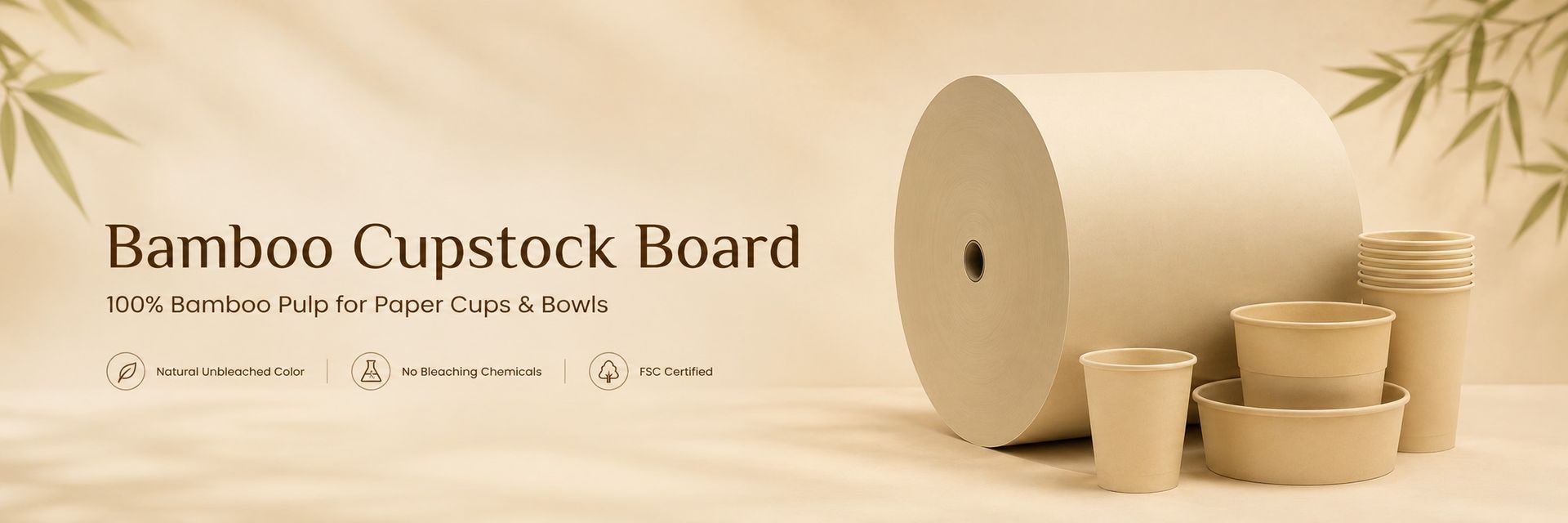
Natural Bamboo Cupstock Paper and FSC Claims: What Buyers Need to Know
Natural Bamboo Cupstock Paper Is Becoming an Important Paper Cup Raw Material
As sustainability becomes increasingly important in the food packaging industry, more paper cup manufacturers are looking for alternatives to conventional wood-pulp cupstock.
One material receiving growing attention is natural bamboo cupstock paper, also commonly described as all bamboo pulp natural color food packaging base paper.
This type of paper is mainly used for producing:
- Paper cups
- Paper bowls
- Soup containers
- Ice cream cups
- Takeaway food packaging
- Other food-service paper containers
Compared with conventional white wood-pulp cupstock, natural bamboo cupstock has a distinctive light brown or natural bamboo appearance that can help brands communicate a more natural packaging image.
However, when buyers start asking for FSC bamboo cupstock paper, one important question often causes confusion:
If the paper mill has an FSC certificate, does that automatically mean every roll of bamboo cupstock produced by the mill is FSC-certified?
The answer is no.
Understanding this difference is particularly important for paper cup manufacturers that intend to sell their finished cups as FSC-certified products.
What Is Natural Bamboo Cupstock Paper?
Natural bamboo cupstock paper is food packaging base paper made primarily or entirely from bamboo pulp and designed for converting into paper cups, bowls and other food containers.
It may be supplied as:
- Base paper rolls
- PE coated bamboo cupstock rolls
- Paper sheets
- Printed or unprinted paper cup fans
- Cup bottom rolls
For example, an all bamboo pulp natural color food packaging base paper may use 100% bamboo pulp as its fiber furnish while retaining the natural color of the bamboo fiber instead of using the bright-white appearance normally associated with heavily bleached cupstock.
For paper cup production, buyers should evaluate more than fiber composition alone.
Important specifications include:
- Base paper GSM
- Paper thickness
- Bulk
- Stiffness
- Moisture
- PE coating weight
- Single-side or double-side coating
- Roll width
- Heat-sealing performance
- Printing performance
- Cup-forming compatibility
A paper can have an attractive sustainability story but still needs stable converting performance on the customer's paper cup machines.
100% Bamboo Pulp and Mixed Bamboo Pulp Are Not the Same as FSC 100% and FSC Mix
This is one of the most important distinctions for international buyers. 100% bamboo pulp describes the fiber composition of the paper. FSC 100%, however, describes the FSC sourcing status of the material. These are not the same concept.
For example:
100% bamboo pulp paper
means the fiber furnish is made entirely from bamboo pulp.
But this does not automatically mean the product carries an FSC 100% claim.
Likewise, a paper made from a mixture of bamboo pulp and wood pulp may still be eligible for an FSC claim if the materials and production are handled according to the applicable FSC Chain of Custody requirements.
Depending on the certified inputs and the FSC control system being used, applicable claims may include:
- FSC 100%
- FSC Mix
- FSC Mix Credit
- Other applicable FSC claims
Therefore, buyers should never determine the FSC status simply from the phrase “100% bamboo pulp.”
The actual FSC status must be confirmed through the certified supply chain and transaction documentation.
What Does an FSC Certificate Actually Prove?
An FSC Chain of Custody certificate proves that an organization has been assessed for its system of controlling, tracking and selling eligible FSC materials and products within the approved certificate scope.
It does not mean that every product manufactured by that company is automatically FSC-certified.
Imagine that a paper mill produces 10,000 tons of natural bamboo cupstock paper.
The mill may hold a valid FSC Chain of Custody certificate, but some orders may be produced and sold as FSC-claimed products while other orders may be sold as ordinary non-FSC-claimed commercial paper.
Therefore:
FSC certificate = certification status of the organization and its approved scope
while:
FSC claim = FSC status assigned to a specific product transaction
This distinction is extremely important.
Why Is the FSC Claim on the Sales Documents Important?
Under the FSC Chain of Custody system, products sold with an FSC claim must be supported by appropriate transaction documentation.
For an FSC-claimed B2B sale, the relevant sales documents normally identify information such as:
- Supplier
- Customer
- Product description
- Quantity
- Supplier's FSC certificate code
- Applicable FSC claim
For example:
Product: Natural Bamboo Cupstock Paper
Quantity: 20 MT
FSC Claim: FSC 100%
FSC Certificate Code: XXX-COC-XXXXXX
Depending on the document flow, related delivery documentation may also carry the necessary information or reference the associated sales document.
This is why an FSC certificate PDF by itself is not sufficient evidence that a particular shipment was supplied as FSC-certified material.
A buyer should be able to connect the FSC claim to the specific commercial transaction.
FSC-Certified Paper Mill vs. FSC-Claimed Bamboo Cupstock: What Is the Difference?
Here is a simple example.
Situation A: Paper Mill Has FSC Certification, but No FSC Claim Is Supplied
A customer purchases: 20 MT Natural Bamboo Cupstock Paper
The supplier provides a copy of the paper mill's FSC certificate. However, the sales documents only state: Natural Bamboo Cupstock Paper – 20 MT
There is no FSC claim linked to that shipment. In this situation, the buyer has evidence that the mill participates in FSC certification, but the buyer does not have an FSC claim identifying that particular 20 MT as FSC-certified input.
Situation B: Bamboo Cupstock Is Supplied With a Formal FSC Claim
The customer purchases: 20 MT Natural Bamboo Cupstock Paper
The applicable sales documentation clearly identifies the FSC status, for example: FSC 100% together with the supplier's valid FSC certificate code.
This allows a certified buyer to receive the material into its FSC Chain of Custody system according to the applicable requirements.
That is a fundamentally different transaction.
A Printed FSC Logo or Stamp Is Not Proof That Paper Is FSC-Certified
This is another important issue buyers should understand.
Sometimes a buyer may see an FSC logo or an FSC-looking stamp on a paper label and assume that this proves the material is FSC-certified.
That is not a reliable way to verify FSC status.
An FSC logo added to a normal paper mill label cannot, by itself, transform ordinary paper into FSC-certified material.
The FSC system is based on traceability, not simply on a logo.
For a buyer, the more important questions are:
Who sold the paper?
Was that supplier FSC CoC certified at the time of the transaction?
Was the product within the supplier's FSC certificate scope?
What FSC claim appeared on the sales documents?
What FSC certificate code was associated with the transaction?
Can the exact batch be traced through the supply chain?
If these questions cannot be answered, a logo or stamp alone should not be treated as sufficient proof.
Can a Distributor With an FSC Certificate Add an FSC Logo to Ordinary Bamboo Paper?
Holding an FSC CoC certificate does not mean that a distributor can purchase ordinary non-FSC-claimed paper, add an FSC logo and then sell it as FSC-certified paper. The FSC status must come through an eligible certified supply chain.
For example:
Paper Mill
↓
Certified Trader / Converter
↓
Paper Cup Manufacturer
↓
Finished FSC Product
When ownership of the FSC product passes between certified organizations, the FSC status needs to be correctly maintained through the Chain of Custody system.
A company cannot create an FSC claim simply because the company itself holds an FSC certificate.
The material itself must also qualify.
This is one of the most important checks when sourcing FSC natural bamboo cupstock paper.
Can You Produce FSC Paper Cups From Natural Bamboo Cupstock Paper?
Yes — both 100% bamboo pulp cupstock and mixed-pulp bamboo cupstock may potentially be used in FSC-certified products, provided the material is supplied with the appropriate FSC status and the complete Chain of Custody requirements are met.
The important issue is not simply whether the cupstock contains 100% bamboo.
The important issue is whether the input material is received with a valid FSC claim that is eligible for the converter's FSC control system.
A paper cup manufacturer that converts FSC paper into finished cups and intends to sell or label those finished cups as FSC-certified products would normally need its own valid FSC Chain of Custody certification, or another applicable FSC-approved certified arrangement.
Buying FSC-certified raw paper alone does not automatically make the finished cup FSC-certified.
The FSC status must be maintained throughout the converting process.
Can a Paper Cup Manufacturer Put the FSC Logo on Finished Cups?
Not simply because FSC raw paper was purchased.
If a cup manufacturer wants to put the FSC on-product label on its finished paper cups or sell those finished products with an FSC claim, the manufacturer must meet the applicable FSC certification and trademark requirements.
In practical terms:
FSC raw paper + non-certified converting process ≠ automatically FSC-certified finished cup
The converting company needs to ensure that the FSC status remains controlled through production.
This includes areas such as:
- Certified input verification
- Material identification
- Inventory control
- Production records
- Volume accounting
- Product group control
- Sales documentation
- Trademark and label approval
This is why FSC is referred to as a Chain of Custody system.
The chain should remain traceable from certified source through processing and finally to the product sold with an FSC claim.
Why Can FSC-Claimed Natural Bamboo Cupstock Cost More?
Buyers sometimes ask:
“If the paper itself looks the same, why does paper supplied with an FSC claim cost more?”
There is no universal FSC surcharge per ton.
However, FSC-claimed orders can involve additional operational requirements for the certified supplier.
Depending on the mill and supply arrangement, this may include:
- Sourcing eligible certified pulp
- Allocating certified raw materials
- Separate production planning
- Maintaining traceability
- Material accounting
- Documentation control
- Certification and audit costs
- FSC transaction management
Some paper mills may therefore quote FSC-claimed production at a different price from ordinary production without an FSC claim.
For buyers, this requirement should always be confirmed before placing the order.
Do not wait until the paper has already been produced to ask for an FSC claim.
How to Order FSC Natural Bamboo Cupstock Paper Correctly
When requesting a quotation, tell your supplier clearly whether you need:
Option 1: Bamboo cupstock from an FSC-certified paper manufacturer, but without a formal FSC claim
or:
Option 2: Bamboo cupstock supplied as FSC-claimed material through the FSC Chain of Custody system
These two requirements are not necessarily the same commercial product.
For an FSC order, confirm the following before production:
- Is the supplying organization currently FSC CoC certified?
- Is the requested product included within the applicable certification scope?
- What FSC claim will be supplied?
- Which FSC certificate holder will issue the claim?
- Will the claim and certificate code appear on the relevant sales documentation?
- Does your own company hold the necessary FSC certification to process and resell the finished product as FSC-certified?
- Is approval required for the FSC logo on the finished packaging?
Clarifying these points before production can prevent expensive misunderstandings later.
How to Check Whether an FSC Certificate Is Valid
Buyers should not rely only on a PDF certificate sent by a supplier.
FSC provides an official certificate search system where buyers can check certification information using:
- Organization name
- FSC licence code
- Certificate code
- Certificate status
- Certificate type
- Product information
Certificates can expire, be suspended or change in scope.
Therefore, when purchasing a large quantity of FSC bamboo cupstock paper, verify the current certification status instead of relying on an old certificate saved several years ago.
This is especially important for long-term contracts and repeat orders.
What Documents Should Buyers Ask For?
For ordinary natural bamboo cupstock paper, buyers commonly request documents such as:
- Technical Data Sheet
- Food contact test report
- Material composition
- Product specifications
- Packing list
- Commercial invoice
For an FSC-claimed order, additional FSC-related verification becomes important.
Depending on the transaction, buyers should confirm:
- Supplier's current FSC certification status
- FSC certificate code
- Applicable FSC claim
- Relevant sales documentation
- Product traceability information
If the bamboo cupstock is subsequently PE coated, printed, die-cut or converted into paper cups, the companies participating in those stages should also confirm how the FSC status is maintained through the relevant certified supply chain.
Natural Bamboo Cupstock Paper for PE Coating and Paper Cup Production
From a manufacturing perspective, FSC documentation is only one part of selecting bamboo cupstock.
The paper must still perform well in actual paper cup production.
When selecting all bamboo pulp natural color food packaging base paper, paper cup manufacturers should also consider:
Stiffness
Good stiffness helps the finished cup maintain shape and improves the hand feel of the cup.
Thickness and Bulk
Two papers with the same GSM may have different thickness and stiffness.
Higher bulk can help achieve better cup rigidity without significantly increasing paper weight.
PE Coating Performance
For conventional PE-coated paper cups, coating uniformity is important for:
- Heat sealing
- Moisture resistance
- Bottom sealing
- Side-wall sealing
- Converting stability
Printing Performance
Natural-color bamboo cupstock creates a different visual result from white cupstock.
Designers should take the natural brown background into consideration when preparing artwork.
White colors and light colors may appear differently compared with printing on bright-white paper.
Machine Compatibility
Paper stiffness, thickness, coating weight and moisture all affect cup-forming performance.
Before changing from conventional wood-pulp cupstock to bamboo cupstock, a production trial is recommended.
100% Bamboo Pulp or Mixed Bamboo Pulp: Which Should You Choose?
There is no universal answer.
100% Bamboo Pulp Cupstock
This option is suitable for customers who want a strong bamboo-material story and prefer the paper fiber composition to be entirely bamboo.
Potential marketing positioning includes:
- Bamboo-based paper packaging
- Natural-color food packaging
- Alternative fiber cupstock
However, remember:
100% bamboo pulp does not automatically mean FSC 100%.
The FSC claim must still be determined through the certified supply chain.
Mixed Bamboo Pulp Cupstock
Mixed-pulp bamboo cupstock may combine bamboo fiber with other virgin paper fibers.
It can be suitable for customers looking for a balance between:
- Performance
- Cost
- Surface quality
- Stiffness
- Supply stability
Mixed pulp does not automatically mean the product cannot be FSC-certified.
Its FSC status depends on the certified inputs and applicable FSC Chain of Custody system.
Common FSC Mistakes When Buying Bamboo Cupstock Paper
International buyers should avoid these common mistakes:
Mistake 1: “The mill has an FSC certificate, so all its paper must be FSC.”
Incorrect.
The certificate alone does not establish the FSC status of every individual transaction.
Mistake 2: “The label has an FSC logo, so the paper must be FSC.”
Not necessarily.
Always verify the transaction documentation and supply chain.
Mistake 3: “100% bamboo pulp means FSC 100%.”
Incorrect.
One describes fiber composition; the other describes FSC sourcing status.
Mistake 4: “We can buy FSC paper and automatically sell FSC paper cups.”
Not necessarily.
If your company converts the paper into a new finished product and wants to sell that product as FSC-certified, your converting operation must also meet the applicable FSC Chain of Custody requirements.
Mistake 5: “We can ask the supplier to add an FSC claim after production.”
This should not be assumed.
FSC requirements should be confirmed before production, because the mill or supplier may need to allocate the appropriate certified inputs and arrange the order through its certified system from the beginning.
FAQ About Natural Bamboo Cupstock Paper and FSC
Is natural bamboo cupstock paper FSC-certified?
It can be supplied as FSC-certified material when the applicable FSC requirements are met and a valid FSC claim is passed through the certified supply chain.
Do not assume that all natural bamboo cupstock is automatically FSC-certified.
Is all bamboo pulp natural color food packaging base paper made from 100% bamboo?
If a product is specifically described as all bamboo pulp, it normally refers to a fiber furnish based entirely on bamboo pulp. Buyers should still confirm the manufacturer's technical specification for the exact grade being purchased.
Does 100% bamboo pulp mean FSC 100%?
No.
100% bamboo pulp describes the fiber composition.
FSC 100% is an FSC sourcing claim.
These terms should not be used interchangeably.
Can mixed bamboo pulp paper be FSC-certified?
Yes, mixed-pulp paper can potentially carry an FSC claim if the materials and manufacturing comply with the applicable FSC requirements.
The exact FSC claim depends on the certified inputs and the supplier's FSC control system.
Is the paper mill's FSC certificate enough?
Not if you need the paper as an FSC-certified input for your own certified production.
The FSC status of the specific transaction should be properly supported by the applicable FSC claim and certificate information.
Does the FSC claim have to appear on the invoice?
For products sold with an FSC claim, the relevant sales documents must contain the required FSC transaction information, including the applicable FSC claim and certificate code.
Depending on the shipment and documentation process, associated delivery documents may also be used as required by the FSC Chain of Custody rules.
Can I put an FSC logo on my finished paper cups?
Buying FSC raw paper alone is not sufficient.
If you manufacture the finished paper cups and want to label or sell them as FSC-certified products, your company normally needs to operate within an applicable FSC-certified Chain of Custody system and comply with FSC trademark requirements.
Why is FSC-claimed bamboo cupstock sometimes more expensive?
The certified supplier may need to source or allocate eligible certified raw materials, maintain traceability and complete additional FSC production and documentation controls.
The actual additional cost varies by supplier and order.
Buy Natural Bamboo Cupstock Paper From a Supplier That Understands the Complete Supply Chain
Buying natural bamboo cupstock paper is not only about GSM and price.
For international paper cup manufacturers, the supplier should understand:
- Bamboo cupstock specifications
- PE coating
- Paper cup converting
- Food-contact requirements
- Printing requirements
- FSC Chain of Custody
- FSC claims
- Export documentation
At Guima Paper, we supply bamboo cupstock and paper cup raw materials for overseas paper cup and food packaging manufacturers.
Available formats include:
- Bamboo cupstock rolls
- PE coated bamboo paper rolls
- Bamboo paper sheets
- Paper cup fans
- Cup bottom rolls
If FSC documentation is required for your project, please tell us before production.
We can then confirm the applicable paper specification, FSC requirement, supply-chain arrangement and documentation before providing the final quotation.
This helps ensure that the material you purchase matches both your production requirements and your customer's certification requirements.
Looking for Natural Bamboo Cupstock Paper?
If you are sourcing natural bamboo cupstock paper, all bamboo pulp natural color food packaging base paper, PE coated bamboo cupstock or bamboo paper cup raw materials from China, contact Guima Paper with the following information:
- Required GSM
- PE coating weight
- Single PE or double PE
- Roll width
- Monthly quantity
- Cup size or application
- Destination country
- Whether an official FSC claim is required
We will recommend the appropriate specification according to your paper cup production requirements.
Natural bamboo cupstock paper should not only look sustainable — its material, documentation and supply chain should also be clear and traceable.
Get In Touch
Tel: +8618378845537
Email: chris@guimapaper.com
- Mon - Fri
- -
- Sat - Sun
- Appointment Only
